Saturday, September 5, 2026 brought a rough round of storms across the Triangle. National Weather Service reports included about 1.5-inch hail east of Knightdale, hail reports around Clayton / Powhatan, and serious wind through Wendell Falls—with downed trees, power outages, and visible property damage in places.
If you live in Raleigh, Knightdale, Clayton, Wendell, northeast Raleigh, or nearby Wake and Johnston County neighborhoods, you do not need to panic—but you also should not assume the roof is fine because the shingles “look okay from the driveway.”
This guide is a practical post-storm roof checklist for homeowners. It explains what to look for, what those signs can mean, and when it is worth getting a documented local inspection. Hail maps and radar estimates are useful for targeting neighborhoods; they are not by themselves insurance proof for any one house.
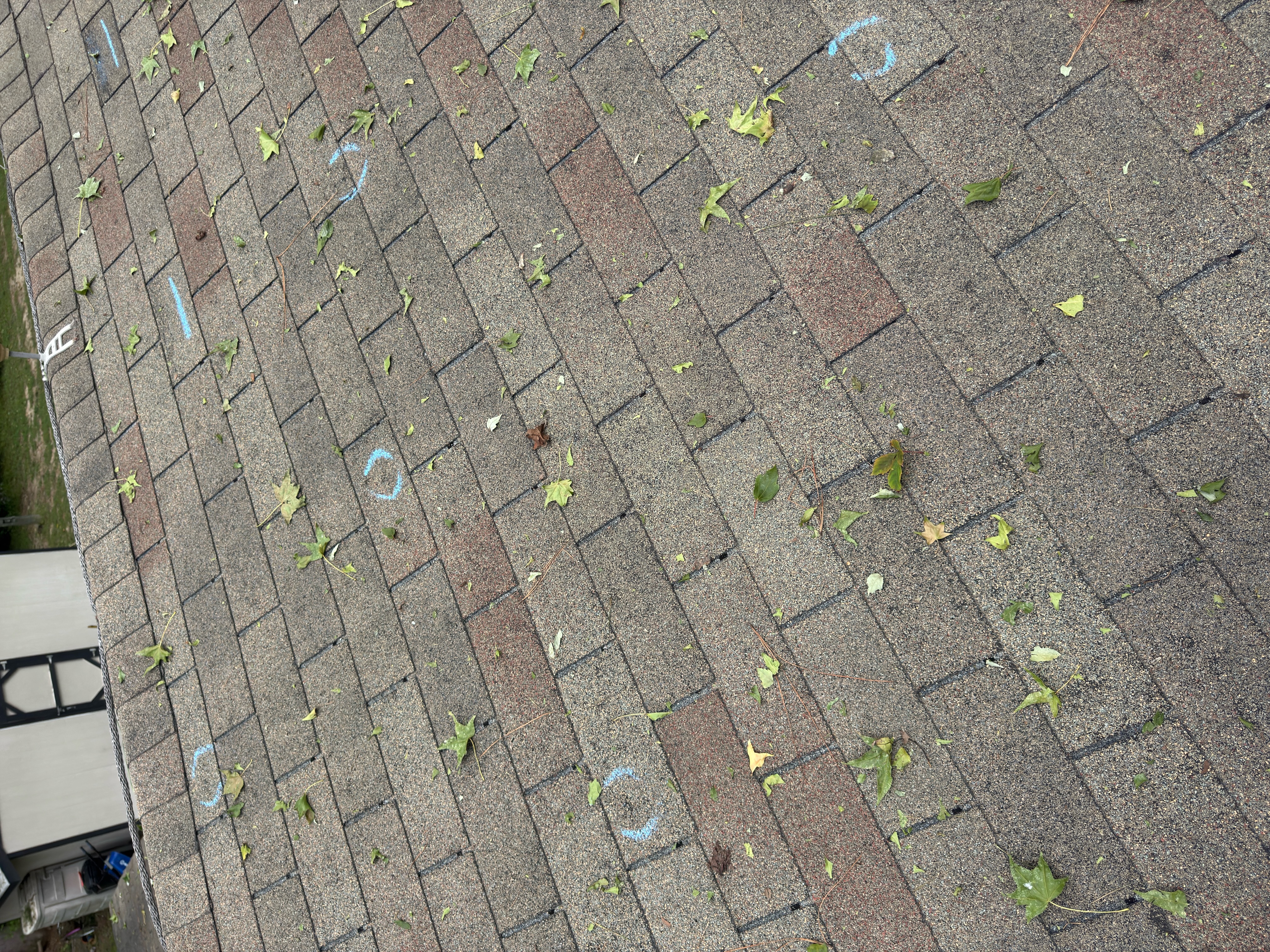
Why a driveway glance is not enough after hail or wind
After a Triangle hail or wind event, many homeowners walk outside, look up, and decide the roof survived. That misses the places storms usually show first:
- Soft metal (vents, caps, flashings) dents more easily than asphalt faces.
- Granules wash into gutters and downspouts after impact.
- Ridge and edges take wind abuse even when field shingles look intact.
- Interior stains sometimes appear only after the next rain.
A careful check now can help you decide whether you need documentation before the next storm cell—or simply peace of mind.
Sep 5 Triangle storm: what local reports showed
Use these as context for your neighborhood, not as a claim about your specific roof:
| Area | What was reported (public sources) | Homeowner takeaway |
|---|---|---|
| East of Knightdale | About 1.5" (half-dollar) hail in NWS local storm reports | Soft metal + granule check first |
| Clayton / Powhatan / Johnston fringe | Hail reports in the half-inch to larger range; strong cells | Same checklist; watch ridge and valleys |
| Wendell Falls / Wendell corridor | High winds, trees down, roof/awning damage reported | Wind uplift, missing tabs, debris impact |
| NE Raleigh / Buffaloe corridor | Outages and storm traffic in the same event window | Inspect after power/tree work is clear |
K&D Roofing is based at 8601 Six Forks Rd., Suite 400, Raleigh, NC 27615. We have been walking roofs in these same corridors as a GAF Master Elite contractor and FORTIFIED-trained team—local since 2017, not a traveling crew passing through.
Post-storm roof checklist (do this safely)
Safety first: Stay on the ground if the roof is steep, wet, or debris-covered. Binoculars from the yard and photos from windows often beat climbing.
1. Soft metal: vents, caps, and flashings
Walk the yard and look at roof penetrations you can see:
- Round roof vents and turbine bases
- Plumbing stack flashings
- Ridge vents and end caps
- Chimney cricket / step flashing (from a safe angle)
What you are looking for: fresh dents, creases, or “oil canning” that was not there before the storm. Soft metal often records hail better than the shingle face.
2. Gutters and downspouts: granules and debris
Check gutter openings and the first few feet of downspout:
- Unusual piles of asphalt granules (looks like coarse sand)
- Shingle fragments or ridge pieces
- Leaf/branch plugs from wind that can hide damage until the next rain
Granules alone do not prove a claim—but a sudden spike after a known hail day is a reason to document.
3. Ridge, hips, and edges
Wind likes edges:
- Missing or cracked ridge cap shingles
- Lifted tabs along eaves and rakes
- Exposed nails or open slots on the ridge
If you can see daylight through a ridge gap or a tab flapping in light breeze, schedule an inspection sooner rather than later.
4. Field shingles (what you can see from the ground)
From the street or backyard:
- Missing tabs or “bald” spots
- Creased or folded shingles (wind)
- Dark blotches that might be granule loss (harder to judge from ground)
Do not diagnose hail bruises from a phone zoom alone—lighting lies. Photos help a pro more than a guess.
5. Attic and ceilings (after the next rain if possible)
Inside the house:
- New water stains on ceilings or exterior walls
- Damp insulation or musty attic smell
- Daylight through the roof deck (rare but urgent)
Photograph stains with a date stamp if you can. That record helps you track whether a spot is new or old.
6. Trees, fences, and AC fins (supporting clues)
Storms that dent soft metal on the roof often leave clues nearby:
- Fresh tree limb scars on the roof or gutters
- Dented fence caps or mailbox tops
- AC condenser fins bent in a consistent direction
These do not replace a roof inspection, but they support the story of a severe cell in your immediate area.
What a documented inspection usually covers
When homeowners in Wake County book a free roof inspection with K&D after a storm cell, a typical visit focuses on:
- Exterior elevations — photos of each roof plane
- Soft metal and flashings — vents, stacks, wall intersections
- Ridge, hips, valleys, and edges — common wind failure points
- Gutter / granule notes where relevant
- Interior spots if you report a leak or stain
You leave with CompanyCam-style documentation—clear photos you can keep for your own records and for any conversation you choose to have with your insurance carrier. We do not promise claim outcomes. Every home and every policy is different.
If another contractor already walked the roof, a second set of local eyes is still reasonable—especially if you only received a verbal “you’re fine” with no photos.
Repair vs replace: how to think about it after one storm
Not every storm visit ends in a full roof replacement. After hail or wind in Raleigh and surrounding cities, outcomes usually fall into a few buckets:
- Monitor — minor cosmetic notes, no active leak path
- Spot repair — isolated wind damage, ridge work, or flashing fixes
- Larger repair / section — when damage clusters on one elevation
- Full replacement — when age, multiple planes of impact, or leak risk make repairs a poor long-term bet
A good inspection explains what was found and options, not a one-size sales script. If you want a deeper decision guide, our follow-up post will cover repair vs full replacement in Wake County in more detail. Our residential roofing page covers the replacement and repair work we do for Triangle homes.
Neighborhoods we are prioritizing after Sep 5
Based on public storm reports and local damage patterns, field attention has been weighted toward:
- Clayton / Powhatan / NC-42 corridor
- Wendell / Wendell Falls
- Knightdale (especially east / ENE of town)
- Northeast Raleigh (Buffaloe Rd and nearby ZIPs)
- Nearby fringe (e.g. Zebulon) as secondary
If you are outside those corridors but saw hail or wind damage, you are still welcome to request an inspection—storm cells are uneven street to street.
How to book a free documented roof inspection
K&D Roofing LLC 8601 Six Forks Rd., Suite 400 Raleigh, NC 27615
Phone: (919) 977-4074 Web: kanddroofingnc.com/contact Credentials: GAF Master Elite · FORTIFIED-trained · Local since 2017
When you reach out, it helps to share:
- Your city / ZIP (Clayton, Knightdale, Wendell, Raleigh, etc.)
- Whether you saw hail, wind, or both
- Any interior stains or missing shingles
- Best time for a visit
We will document what we see and walk you through next steps in plain language.
FAQ: Sep 5 storm roof questions (Raleigh area)
Do I need a roof inspection after every thunderstorm?
No. Focus on cells with reported hail, high wind, or visible debris/tree damage near your home. The Sep 5 event fits that bar for several Triangle corridors.
Can I tell hail damage from the ground?
Sometimes—especially on soft metal—but many bruises are subtle. Ground photos plus a professional walk are more reliable than a driveway glance.
Should I file an insurance claim before anyone looks at the roof?
Not always. Many homeowners prefer documentation first so they understand what is on the roof before they involve their carrier. Policies and deductibles vary; we do not tell you what your carrier will pay.
What if another roofing company already came out?
Ask for their photos. If you only got a verbal opinion, a second documented look from a local GAF Master Elite contractor can clarify what was missed—or confirm you are in good shape.
How soon after Sep 5 should I schedule?
Sooner is better while storm memory is fresh and before the next rain makes stains worse—but a careful inspection still helps weeks later if you have not had one yet.
Do you serve Cary, Durham, and other Triangle cities too?
Yes. This post emphasizes Sep 5 hard-hit corridors; K&D also serves greater Raleigh-area homeowners, including Cary and Durham. Start at our residential roofing and contact pages.
Bottom line for Wake County homeowners
The Sep 5 Triangle storms left a real footprint in Knightdale, Clayton, Wendell Falls, and parts of Raleigh. Use the checklist above, photograph what you can from safe ground, and book a free documented inspection if anything looks off—or if you simply want confirmation from a local Master Elite team.
Call or text (919) 977-4074, or request a visit at kanddroofingnc.com/contact. K&D Roofing LLC · 8601 Six Forks Rd., Suite 400, Raleigh, NC 27615.